-
Sep 24, 2026, 10:05 am934 pts Special Content
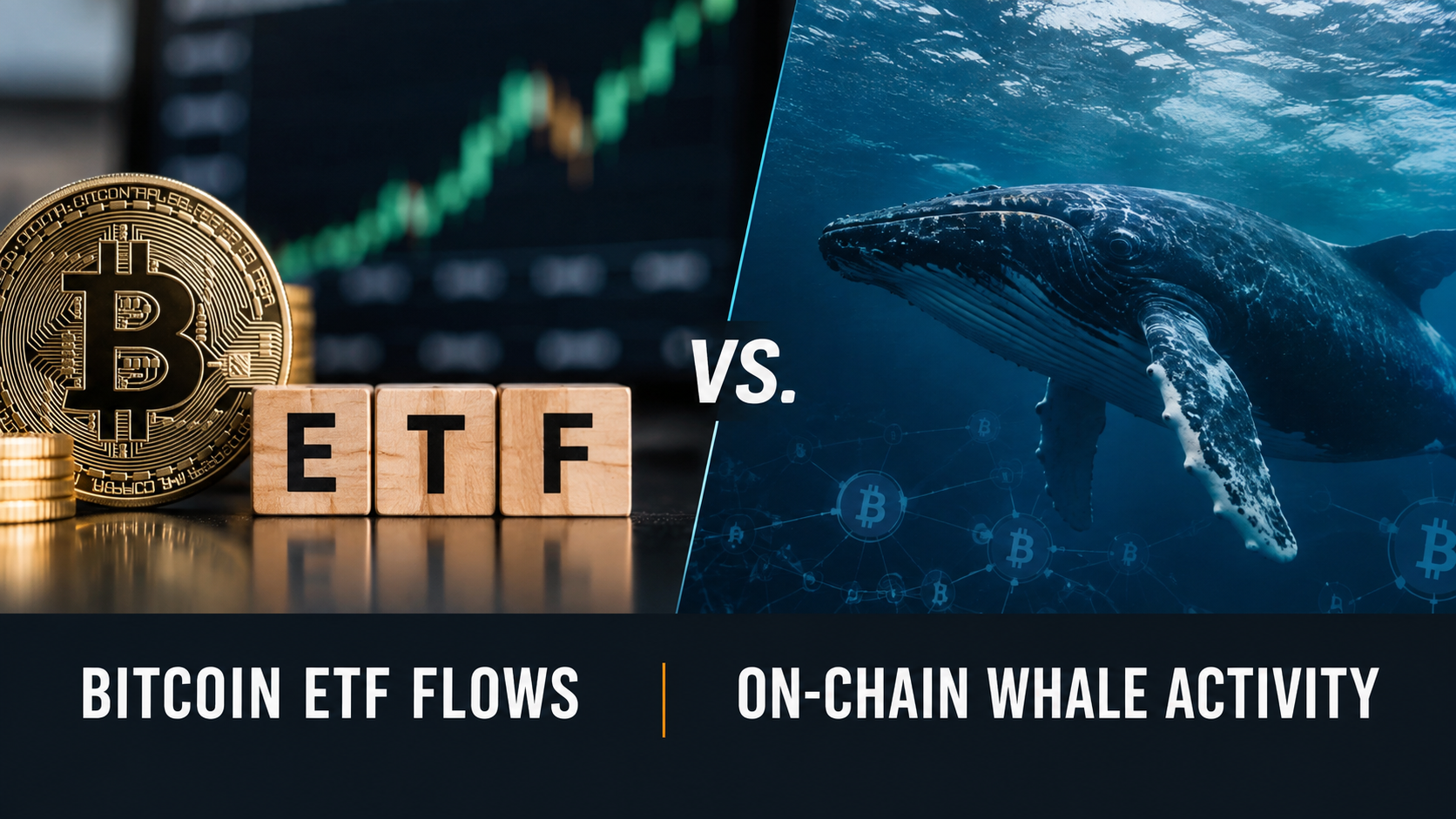
Bitcoin ETF flows track net capital entering or leaving through primary-market creations and redemptions. On-chain whale activity tracks large BTC movements between wallets, exchanges, custodians, and other addresses. ETF data follows a defined fund mechanism, while whale data covers more of the network but often leaves the reason for a transfer unclear.
Key Takeaways
- ETF flows come from share creations and redemptions, not ordinary ETF trading between investors.
- Secondary-market price gaps can encourage authorized participants, or APs, to create or redeem shares around net asset value.
- Large whale transfers do not automatically mean buying or selling because coins can move without changing ownership.
- Exchange deposits and withdrawals add context but still require interpretation.
- ETF data is narrower and more interpretable; whale data is broader but more ambiguous.
What Are Bitcoin ETF Flows?
Bitcoin ETF flows measure the net value associated with shares created or redeemed through the fund's primary market.
What an ETF inflow means
ETF shares trade between investors on the secondary market. Those trades change ownership but do not automatically create new shares or count as fund inflows.
Creations happen in the primary market, where APs transact with the fund in large baskets. APs and market makers watch the ETF's market price relative to net asset value, or NAV. When a price gap creates an arbitrage opportunity, APs may create or redeem baskets, helping keep the market price close to NAV.
A net inflow means creations exceeded redemptions. Depending on the fund, creations can be settled with cash, Bitcoin, or both. Since July 2025, SEC-approved crypto ETPs may support in-kind creations and redemptions.
What an ETF outflow means
A net outflow means redemptions exceeded creations. It is not the same as investors selling ETF shares, because another investor may buy them without any primary-market redemption.
For redemptions, APs return baskets and receive cash or Bitcoin under the fund's approved process. ETF flow data therefore excludes direct spot purchases, private funds, OTC activity, corporate treasury transactions, and other Bitcoin exposure.
Read more: BlockFi Bitcoin Rewards Credit Card Waitlist Now Open
What Is On-Chain Whale Activity?
A Bitcoin whale is a wallet or entity controlling a large amount of BTC, although thresholds vary.
Common signals include large transfers, exchange deposits and withdrawals, and changes in balances held by large-address cohorts.
A 5,000 BTC transaction could be a deposit before a sale, a withdrawal into cold storage, a transfer between wallets owned by the same institution, a custodian restructuring storage, or an OTC settlement. The blockchain records the movement, but transaction size alone does not reveal economic intent.
Bitcoin ETF Flows vs. Whale Activity: Key Differences
Factor
Bitcoin ETF Flows
On-Chain Whale Activity
What it measures
Net primary-market creations and redemptions
Large Bitcoin movements on-chain
Main participants
ETF investors, advisers, APs, market makers, institutions and retail investors
Whales, exchanges, custodians, funds and miners
Data source
ETF and fund reporting
Bitcoin blockchain and analytics platforms
Link to buying/selling
Reflects changes in fund share supply
A transfer may occur without a purchase or sale
Market coverage
ETF channel only
Broad blockchain activity
Main limitation
Misses activity outside ETFs
Wallet identity and transaction intent can be unclear
Best use
Tracking capital moving through Bitcoin funds
Tracking large-holder and custody-related movements
These signals are also easier to interpret when viewed alongside the current Bitcoin to USDT price, spot trading volume, and overall market liquidity.
The practical difference is interpretability versus coverage. ETF flow data describes a narrower, defined channel. Whale data reaches further across the network but leaves more uncertainty about who moved the coins and why. The datasets complement each other.
Why Can ETF Flows and Whale Signals Point in Opposite Directions?
They can diverge because they track different participants, venues, and time horizons.
Scenario 1: ETF inflows rise while whales send BTC to exchanges
ETF creations may be positive while large holders move BTC to exchanges. The first signal shows capital entering the ETF structure. The second shows more BTC becoming available for trading or sale, but does not prove it will be sold.
Scenario 2: ETF outflows occur while whales withdraw BTC from exchanges
ETF redemptions can exceed creations while large balances leave exchanges. Those withdrawals could reflect self-custody, institutional custody changes, internal wallet management, or longer-term storage.
Without entity-level evidence, exchange withdrawals are not proof of accumulation or new buying.
Scenario 3: Both datasets appear to align
ETF inflows alongside falling exchange balances can show capital entering funds while less BTC remains on exchanges. That can reduce immediately available supply, but withdrawals do not establish who bought the coins or when.
ETF outflows alongside rising exchange deposits can show capital leaving funds while more BTC becomes available on exchanges. Deposits can increase potential sell-side liquidity without confirming a sale.
Which Whale Metrics Are More Useful Than Watching Large Transactions Alone?
Aggregated metrics usually provide more context than individual alerts.
Exchange inflows
Large deposits can increase Bitcoin available for trading, collateral, or potential sale. A deposit does not reveal the holder's next action.
Exchange outflows
Withdrawals reduce exchange balances and may reflect self-custody or other storage. Custodian migrations and internal wallet transfers can create similar patterns.
Whale balance trends
Tracking whether large-holder cohorts consistently increase or reduce balances over time can be more useful than a single transfer.
Entity-adjusted data
Some analytics providers cluster addresses believed to belong to the same entity, reducing distortion from internal transfers.
How Should Traders Read ETF Flows and Whale Activity Together?
A simple workflow helps keep the signals separate before combining them.
Step 1: Identify the ETF trend. Check whether primary-market flows are consistently positive or negative across several sessions rather than reacting to one large day.
Step 2: Check where whale Bitcoin is moving. Separate exchange deposits, withdrawals, custodian movements, and ordinary wallet-to-wallet transfers.
Step 3: Look for confirmation. Compare both datasets with spot price, volume, exchange balances, open interest, funding rates, and liquidations to distinguish spot activity from leverage or broader liquidity changes.
Step 4: Consider the time horizon. ETF flows follow market trading days and are usually summarized after the close. On-chain transfers happen continuously and can reflect short-term liquidity needs or longer-term custody decisions.
Common Mistakes When Reading ETF and Whale Data
- Treating secondary-market ETF buying as automatic share creation.
- Assuming every whale deposit means an immediate sale.
- Treating every exchange withdrawal as accumulation.
- Comparing ETF flows without considering fund size or market volume.
- Counting internal exchange or custodian transfers as genuine whale positioning.
- Ignoring derivatives and broader liquidity conditions.
Blockchain transparency shows that a transfer happened, not why it happened.
Two Different Windows Into Bitcoin Market Behavior
ETF flows track capital moving through primary-market creations and redemptions. Whale analytics track large Bitcoin movements across the blockchain, often with less certainty about ownership and intent.
Together, they can show whether ETF demand coincides with changes in exchange balances, custody patterns, or large-holder activity. ETF trading is not the same as fund flow, and an on-chain transfer is not a confirmed purchase or sale.
FAQs
Do Bitcoin ETF inflows automatically push Bitcoin prices higher?
No. They show net creations through the ETF structure; Bitcoin prices also reflect activity across spot, derivatives, OTC, and other markets.
Does a whale sending Bitcoin to an exchange mean they are selling?
No. The transfer makes BTC available on the exchange, but it can serve trading, collateral, custody, or operational purposes.
Are Bitcoin ETF flows considered on-chain data?
No. ETF flows are fund-market data based on creations and redemptions. Related custodian transfers can separately appear on-chain.
Can ETF activity appear in whale-tracking data?
Yes. Custodian transactions linked to ETF operations can appear as whale-sized transfers, so not every large movement represents an independent whale decision.
Which indicator is better for tracking institutional Bitcoin demand?
They measure different channels. ETF flows show activity through Bitcoin funds, while on-chain analytics cover more large holders but require more interpretation.
Trending Today on MacHash












MacHash is your real-time Apple news aggregator, delivering the latest headlines on Apple, Mac, iPhone, iPad, and iOS from top sources across the web.
As a powerful content discovery platform, MacHash continuously curates breaking news, product announcements, software updates, reviews, and industry insights related to Apple Inc. and its ecosystem.
MacHash helps you stay informed on everything from macOS and iOS developments to Apple Watch, AirPods, and the latest in tech and app innovation.
Access MacHash from your desktop or mobile device to explore, follow, and share the most trusted Apple news all in one place.